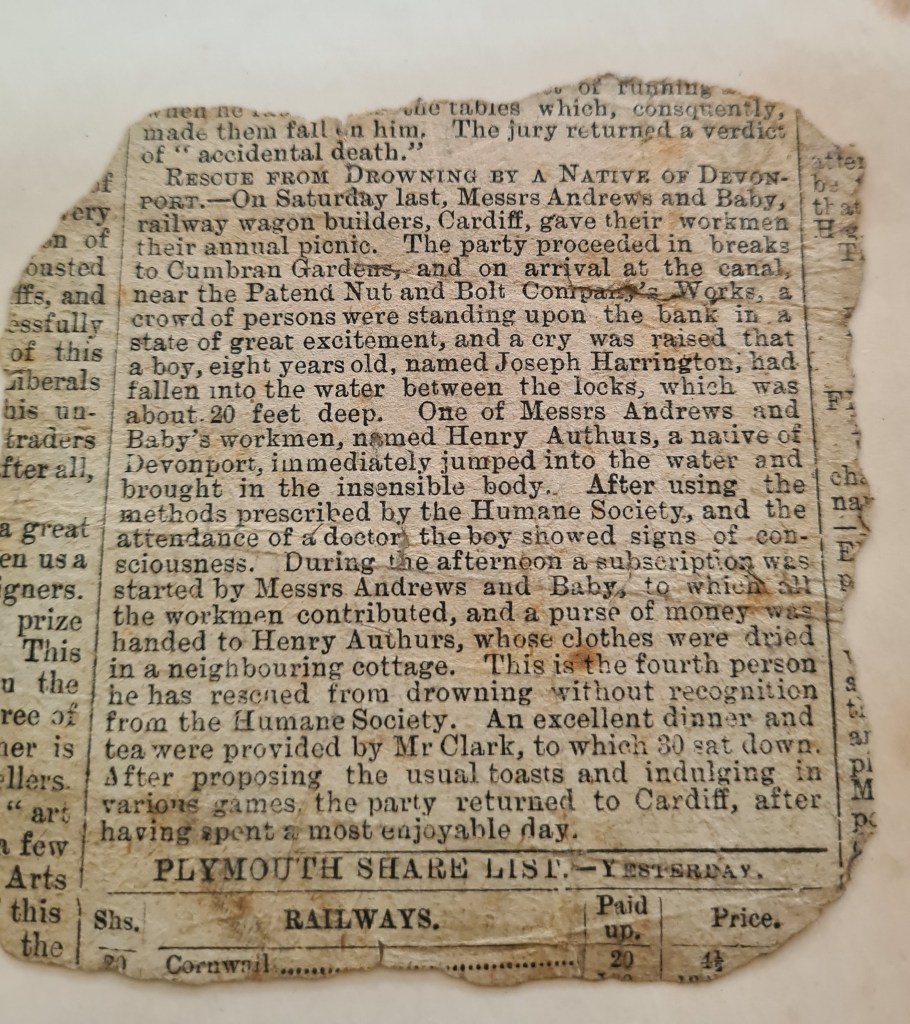
You’d be forgiven for wondering what a tatty scrap from a newspaper cutting has to do with International Clinical Trials day 2026. An account of a workman’s annual trip that ended in near disaster – an 8 year old boy had fallen into the canal near Cwmbran and by the time his body was brought out of the water he had no signs of life. A cry was let out and I can only imagine the panic and dismay of those at the scene. However, all was not as lost as they might have thought – there was a bystander. Someone who had been attending the picnic. Someone who knew what to do, and saved the boy’s life. That man was called Henry Authors.
Some years ago, I was given a family Bible. One of those massive books with a very fancy clasp. I don’t think it had been touched for years. I had been undertaking some research (and no that’s not the link!) into my family history and another family member had offered me the baton of stewardship. I was pleased to receive it and enjoyed filling in the gaps of the tree I’d been working on – all of these people I’d never heard of suddenly present in my mind as I linked them with others that had come afterwards. I carefully turned each page and was delighted to find little snippets of history – some hand made bookmarks, and handwritten entries. Then I came across this small newspaper cutting that I now know is from 1884. Henry Authors was my 4x great grandfather.
Founded by 2 doctors, the “Humane Society for the recovery of persons apparently drowned” was started in 1774. Wanting to promote the value of human life, describe practical actions anyone could undertake to attempt a rescue, and honour those who put themselves forward to save those in peril, the society (now called The Royal Humane Society) remains to this day and their website states that 90,000 rescue cases have been recorded to date. By 1884, the society had not only been advertising their methods but had also been undertaking research (there it is!) which eventually led to a change from dangerous practices and a refinement of the techniques. These techniques were widely published and distributed via pamphlet. Rewards were given to persons who had undertaken rescue attempts and just 4 years after Henry Authors successfully rescued Joseph Harrington using their techniques, there is record of the society branching as far as Australia to continue their work.
By today’s standards, of course, the techniques are obsolete and are no longer recommended. But that, I think, is the point of my blogpost today. In 1884 my ancestor Henry Authors had saved 4 people by using the methods promoted at that time with the best available information and evidence that they had. It had been thoughtfully and systematically developed and the content informed by careful study and analysis of all of the options. But that wasn’t the end of the story. Resuscitation techniques even today are being refined – research is making things better and always will be.
I am proud to work in research – work we are doing today is making the lives of patients better right now. It is incredible to see the cutting edge of research and the impact it has. It’s exciting, it’s dynamic, and it’s powerful. What the next 150 years of research will bring, who knows. But I hope that in 150 years one of my descendants might uncover my story in a dusty archive somewhere and look back in pride that I was part of a little bit of research history myself. Who knows, perhaps they too will be playing their part in the rich work of making things better for the next generations to come.


